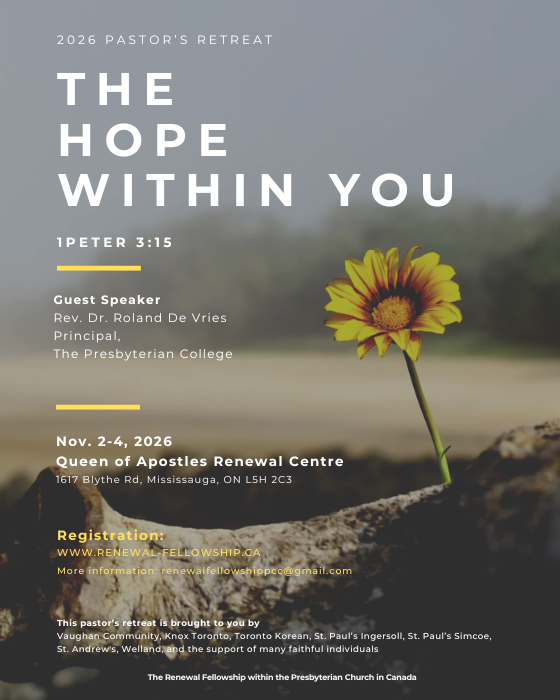
What – Annual PCC Pastor Retreats have been held the first Monday in November since 2022. They are organized primarily by The Renewal Fellowship, with inspiration and primary financial support from Vaughan Community Church. All ministers and pastors in PCC congregations or aligned ministries and expressions are welcome. Content and worship is firmly rooted in reformed Christian orthodoxy.
This year’s theme – “The hope within you”, based on 1 Peter 3:15 – As followers of Christ and as pastoral leaders we are invited to celebrate the hope that is ours in Christ – a hope that is intimately ours and also mysteriously ours. In our time together, we will consider the nature of our Christian hope and also explore what it means for us to nurture this hope. Our cultural moment is one in which it is easy to lose hope, and one in which many experience life precisely as hopelessness. As we face this challenge we will remember our hope and claim our hope and be encouraged to live in hope, through the One who is our hope.”
Speaker – Rev. Dr. Roland DeVries, principal of Presbyterian College in Montreal.
Schedule and Program – The retreat kicks off at noon Monday Nov. 2 with lunch, and ends with lunch on Wednesday, Nov. 4. Each day will include worship, presentations from our speaker, small group discussions and generous opportunities for quiet time. Two spiritual directors will be present for one-on-one sessions, if desired.
Location – Queen of Apostles Renewal Centre.
Cost – We are holding the registration fee at $100. We are able to do this because of the generosity of Vaughan Community Church, along with Knox Spadina in Toronto, Toronto Korean, St. Paul’s Ingersoll, St. Paul’s Simcoe, St. Andrew’s Welland, and many faithful individuals and families. The actual cost for this year’s retreat will be approximately $570 per person. We are asking pastors to prayerfully discern whether they can make an additional donation of any amount. (Please consider sharing this request with your Session.)
Travel subsidy – This is available for those travelling from 500 km or more. To calculate, take the one-way Google Map driving distance and divide by 10. For example, if the driving distance is 500 km, subsidy would be 500/10 = $50.
To Register: Fill out the Registration Form below, and send the refundable Registration Fee of $100 by eTransfer to the Registrar at renewalfellowshippcc@gmail.com, or send a cheque to the Renewal Fellowship Office.
Organizing committee – Rev. Allan Brouwer (convenor), Rev. Andy Cornell (secretary), Rev. Paul Johnston, Rev. Sandy Copland Dufour, Rev. Jinsil Park, Pastor Ronda Bosch, Kyoungsoo Hwang (administrator), Pastor Temeka Williams (music/worship director), Rev. John Baik, Rev. Joe Bae.
In these days of relativism, deepfakes, and social media, young people are looking for truth that they can believe in and real people that they can connect with. The future of the church is with the young, and God is definitely at work on university campuses! Our guest speaker this year was Rev. Dr. Todd Statham, who shared from his experience as the Christian Reformed campus pastor at The University of British Columbia (Okanagan), where he coordinates the Multifaith Chaplaincy and also teaches as a sessional lecturer. Todd is a graduate of The Presbyterian College (2003) and served with the PCC in Malawi as a lecturer at Zomba Theological University (2011-14). He and his family live in Kelowna, B.C. The Annual Reports for 2025 presented at the Annual General Meeting can be viewed or downloaded in printable PDF format. The Renewal Fellowship within The Presbyterian Church in Canada relies entirely on grants, gifts, tithes, and bequests. We receive no funds from any denomination. This allows us to operate independently but does not provide any ongoing security. Your gift allows us to continue to do what we are doing. Go to our Support Renewal page for various options on how to donate. If you have not renewed your $10.00 membership or donated in the past year, the easiest way to renew or donate is by Interac e-Transfer to renewalfellowshippcc@gmail.com or go to our Membership page for additional options. Watch the video of the Annual Meeting, including Dr. Todd Statham’s talk, which starts at the 24:54 mark: June 2 – 6:02 p.m. After the first day and a half, this has been the most collegial General Assembly I’ve attended. My experience goes back only a decade, mind you. Courtesy abounds. Part of the reason may be that there’s been nothing theologically contentious so far. Opening worship was almost like going back in time. Central Presbyterian Church in Hamilton is an old school setting. No power point screen in sight. String quartet and choir. Old hymns. Psalm 100 sung using the same words and music as 1875. Only one contemporary song (a Getty/Townend number) but it came across like a hymn with the pipe organ. The Great Prayer of Thanksgiving was spoken using the male pronoun. Outgoing moderator Pat Dutcher-Walls preached on the GA theme passage of Jeremiah 29:4-14. Hope and a future. Will we act on God’s word and promise and trust that we have a bold future in and post-Babylon or do we wither and die? The suggestion is that the hope lies in the well being of our neighbour. Social justice for sure, but not much talk about salvation. Encouraging, yes. But, respectfully, it’s thin Gospel. Despite the nod to history, the rich and powerful music and the liturgical tone of praising God Most High, opening worship still fell short. There was no encouragement or equipping to reach those who live in spiritual darkness. That is the primary work of the church and it was absent. The Prayer Room was announced publicly and folks are asking us about it. But only the co-chaplain and I turned up for Monday morning prayer at 8 a.m. Three of us gathered for prayer prior to the afternoon sederunt today. It will take time for word to get out. Narratives of Hope and Possibility may be the major issue of this GA and it dominated most of Monday morning. The report was described, the vision shared and the “urgency” of action was made clear. It’s a lengthy document and I urge you to read it. Here’s an excerpt: “We can envision a preferred future of fewer congregations, resulting from purposeful amalgamations or dissolutions, rooted in a narrative of hope and possibility, which locates our collective identity and purpose beyond the confines of the local congregation. Those congregations would be supported by larger, regional presbyteries who would be resourced with regional staff and structures that easily link to other presbyteries and national resources.” The latest financial reporting indicates only two years of operating reserves to cover annual deficits. Actual discussion and voting on the recommendations has been moved to Wednesday. Initial blush from 20-minute group discussion by commissioners indicates a mix of “Let’s do this!” to “Let’s not take power from congregations.” Stay tuned for robust discussion Wednesday. The highlight so far was the message during Monday worship. Richard Topping was at his quotable best: “Sometimes we love mid-century modern. And I don’t mean the furniture.” John 20-21 — Jesus appears to His disciples and sends them. So yes, let’s look forward and not be afraid of change. (For the record, Richard is on the Narratives of Hope committee.) But let’s also be mindful of the primary mission of the church: “The first order of business in the church is to point others to Jesus Christ.” Yes, the One who fed and healed. But also the One who wholly denied himself and submitted to the Father’s will. On tap – an evening of music and memories in a 150th anniversary celebration. Report to come. June 3 – 9:07 p.m. First – Monday night music. The 150th anniversary of the PCC was celebrated with a live musical buffet of choral, classical, contemporary, Indigenous and bluegrass/folk. The evening ended with Electronic Dance Music by Austin Penner – professional DJ and future minister. Tuesday’s highlight was the lengthy and spirited presentations and discussions over the PCC’s response to Israel and Gaza. Before it even began, a commissioner tried to have the entire International Affairs Committee’s report thrown out on the allegation that it was too one-sided against Israel, but it was denied by the moderator. First, the court heard from Corey Balsam of Independent Jewish Voices Canada – a grassroots group that’s highly critical of the Jewish state’s occupation of Gaza and support Palestinian rights. “The answer to trauma is not more trauma . . . hold Israel and its supporters to account” – he told commissioners. The report called on the church to hold Israel to account “for its use of weapons of war primarily against a civilian population in violation of International Humanitarian Laws.” Presenting the report, a committee member commented: “there is undeniable evidence from multiple sources that the Israeli government has committed war crimes . . . the goal is genocide carried out a calculated way.” Commissioners were divided on a recommendation by the committee that “individuals, groups and organizations” within The PCC boycott “goods and services (including financial investments) that support the Israeli military occupation of Palestinian territory and resultant economic oppression of the Palestinian people.” Some speakers were not comfortable with the fact that the report was one sided against Israel, it did not address the actions of Hamas, nor did it cite other human rights by other nations. Others stood with the civilian victims and urged the church to take action and show support in a tangible way. In the end, the recommendation was adopted. Things got more heated during discussion on an additional motion by commissioner, who asked the court to distance itself from the committee’s report, which labeled the Jewish state as “imperialist” and “colonial” rather than “the restoration of self-determination for an historically oppressed people.” Said one commissioner: “It’s a horrible situation in Gaza, which must be addressed, but the discussion should not be based on falsehoods.” An attempt by another commissioner to refer it back to the committee for study and report in 2026 failed. Commissioners continued to debate. Rabbi David Mivasair, who accompanied Corey Balsam and is a fellow critic of his homeland, was invited to chime in. In his view, “colonialism is a perfect description. He added: “If you are confused, you don’t know the facts or are afraid to use the language of what is taking place.” In the end, the motion was defeated. In the Life and Mission Committee report, commissioners were asked to direct presbyteries to seek explanations from congregations who are lagging in financial support for Presbyterians Sharing. Last year $4.5 million came from congregations, down from $4.8 million in 2023. Of 776 congregations, 89 gave nothing and 330 gave less. Those who gave less than 2.5 percent of their dollar base – which is 27 per cent of congregations – were asked to provide an explanation to their Presbytery and present a plan for how they will support Presbyterians Sharing in 2025. Commissioners narrowly agreed with an amendment to do away with pressuring congregations to devise a plan to increase support, but the explanations would be sent to LMA and shared with 2026 General Assembly. The rationale: virtually every congregation already has an approved budget for the year. Any conversation would not happen until at least the fall, which leaves little time to rustle up the extra cash — even if a congregation decided to increase its support. While the intent is to seek good stewardship, the approach comes across as somewhat paternalistic or heavy handed. The mover of the amendment described it as a “pastoral approach — rather than assuming these congregations are automatically in the wrong, let’s start a conversation.” Why are congregations not paying up? The findings may cast some light on what’s broken. Might a future Assembly make whatever changes are necessary for congregations to regain confidence in the PCC? “There’s a larger story here. Let’s discover it and tell it.” General Assembly continues Wednesday with the eagerly anticipated discussion on the Narratives of Hope and Possibility. June 4 – 9:34 p.m. What a difference a day makes – or a few hours sleep. At the close of Tuesday’s business, commissioners amended the Life & Mission Agency’s (LMA) recommendation to ask congregations which provide little or no financial support through Presbyterians Sharing (PS) to come up with a plan to do so. The amended motion was to ask presbyteries to find out why and report the findings so they could be shared at GA 2026. On Wednesday morning, commissioners agreed to allow presbyteries to share that info anonymously. The hope was that that would be the end of it. But commissioners had other ideas. A further amendment to have all congregations – including those who give generously – explain why they give was defeated. Discussion went on and opinions were all over the map to the degree to which this would be useful. Then came a successful motion to refer the amended motion back to LMA. It was a bit of a letdown — so much for allowing the stories to be told. While the official encouragement to share our stories won’t happen – for now – at least the committee leadership and the denomination’s officers were listening closely. The big news Wednesday was how commissioners received and reacted to the report on Narratives of Hope and Possibility. This initiative was created by the Assembly Council (AC) in November 2023 following roundtable discussions by commissioners at that year’s GA in Halifax. Its mission was to explore options of denominational revitalization. The report was developed by a 23-member working group appointed by AC which attempted to represent the PCC’s cultural, demographic and theological diversity. The group believes that the PCC “is ready for revitalizing change that leads to transformation at every level of the church’s life.” Biblical inspiration came from the resurrection stories of John 20-21: “Jesus shows up, Jesus sends us.” The group presented a “preferred future” for the PCC “where, at every level, there is permission to risk, for the sake of the gospel of Jesus Christ. Permission to risk isn’t actuarial, lowering the stakes or building a larger safety net. It is readiness to trust God and willingness to learn from failures and mistakes. This is decidedly uncomfortable. We can’t imagine our whole church becoming comfortable with risk-taking. We can imagine a church that gives permission for risk-taking even when it’s uncomfortable. That’s what happened on the beach with Jesus when his friends hadn’t caught anything after doing what they knew how to do, even with their best effort. Jesus told them to try something new. Cast the net in a different direction.” Specifically, the group offered a “preferred future of fewer congregations, resulting from purposeful amalgamations or dissolutions, rooted in a narrative of hope and possibility, which locates our collective identity and purpose beyond the confines of the local congregation. Those congregations would be supported by larger, regional presbyteries who would be resourced with regional staff and structures that easily link to other presbyteries and national resources.” (There’s no space here to fully summarize the vision. Go to the GA page of the PCC website and on the “Reports, Information and Forms for General Assembly” link and download “Assembly Council – revised”.) All of this was presented with sense of urgency. Members told commissioners that during their consultations with Presbyterians from coast to coast they detected a level of “desperation” for change or relief among many people. Many ministers are overworked, resources are unevenly distributed, head office is running out of money to cover its sizable operating deficit — we’re real estate rich and cash poor. Commissioners approved the recommendation to appoint a Special Commission, to be known as the Change Leadership Team, for a two-year term. The commission has significant power as a “delegated court” of the PCC. One commissioner attempted to downgrade this to a “committee” to make it more accountable to GA, but this failed to gain enough support. Another commissioner tried to refer the entire Narrative report to presbyteries and congregations for study and report – which is common practice with new initiatives. In the words of one commissioner: “this report proposes generational change of great magnitude and not enough time or consultation was taken to bring us to these recommendations.” However, most commissioners appeared to trust the leadership and felt the urgency was too great to wait. The only addition to the recommendation was to direct the commission to “collaborate” with lower courts in its work. Commissioners then appointed a slate of commissioners — individuals who were pre-selected. Unfortunately, we cannot tell you who they are because the supplementary report which named them and provided bios was only briefly shown on the screen prior to the vote. We’re told it will be uploaded to the PCC website on Thursday. On a positive note, the day began with yet another fine message based on the stories of the risen Christ sending his disciples, as described in John 20-21. “Jesus has set his disciples from the locked room to preach good news, proclaim peace and forgive sins,” said Rev. Nick Renaud. “Jesus continues to go ahead of his church in the world . . . Find places where he is now and join the work He is doing. The fire’s made, the fish is ready, there is bread to share and bring the fish you have caught.” For the record, all three morning times of worship have been graced with solid and Biblical messages which point to reconciliation of our sinful souls with the risen the Lord as the greatest imperative of the church. A very refreshing change from some previous Assemblies. GA wraps up Thursday morning. June 5 – 11:11 a.m. Further thoughts on the Narratives of Hope & Possibility and the commissioning of the Change Leadership team. In preparation for GA and the consideration of this report, I had prepared a critique which highlighted two primary concerns. Regarding the future with fewer and larger congregations which are part of a regional partnership and are more strategically located – the implication is that smaller, struggling congregations with no hope of ever calling a pastor are a drain on the system and are essentially a bad thing. Is bigger actually better? The reality is that the church is alive in places where 10, 20 or 30 people are gathered. Every week, these tiny congregations – and there are hundreds of them – gather like family to hear the Word, pray, sing and practice community. They may be stuck in a different era. But the Light of Christ is shining. I can point to the congregation where I am interim moderator, where a grandfather appeared with one of his grandchildren, where a small group of university students bypassed the vibrant church with a praise team and youth pastor because they would rather sit among stained glass and sing old hymns with people old enough to be their grandparents. I see the young mom and her daughter who feel at home there. I see marriages and baptisms. I see vibrant midweek Bible study and conversation. If that congregation was to be closed – even if it’s with a larger “purpose” in mind – most of those folks have no desire or energy to go church shopping at the age of 80 and they would spend the rest of their lives without a church home. They would no longer have that opportunity for Jesus to show up. They do not need Presbyterian Assistance in Dying. Great life can be found in death – it is part of the mystery of life. Jesus shows up in these places. Allow those congregations to die naturally. A second major issue concerns property, buildings – and mission. The report stated: “A preferred future requires us to have a vision and a plan, so that we share the responsibilities and possibilities of the use of property for ministry and mission. National resources can help congregations by providing a theological and missional approach to property.” What does “providing a theological and missional approach” mean in practical terms? This sounds like the denomination imposing a specific shared theology and mission onto local congregations. If so, it does not respect the presbytery as the seat of power, where its primary mission is the health of its congregations, which operate in local context. It does not respect diversity – cultural and theological. Unfortunately, I had no opportunity to voice those concerns. Neither did anyone else. When the report was presented, the authors provided an introduction. Then the commissioners were invited to gather in small groups and talk about it for about 20 minutes. Then we were invited to share with the rest of assembly what our groups were saying. Then we broke for lunch with the promise that the matter would return on Wednesday. When the day arrived, we were greeted with a motion to authorize the commission. It’s normal procedure and typically kicks off the discussion. But before that happened, there was an amendment, then an immediate motion to refer the matter to lower courts for study and report. I was in favour of the referral, but unfortunately, with such motions we are only allowed to discuss “if” it should be referred, “where” and “when.” No discussion of the substance. I have no problem with order and process. In fact, it is vital. But I am disappointed that commissioners were asked to commission a group with significant power – one which essentially removes authority from the 2026 Assembly over this matter – with no substantial discussion. Given my adherence to process, I must trust that the commission will seek God’s will even though commissioners had no opportunity to discuss the recommended terms of reference. A 20-minute chat was woefully inadequate. Special arrangements could have been made for GA to go into an informal committee-of-the-whole – or some other framework – for discussion and Q&A. And now to the final sederunt. The highlight of the final sitting was the report of the Young Adult Representative (YARs). Rather than a single report, each of them provided personal comments. Most were expressions of appreciation and courtesy. A few of them, however,stood out. Three young women provided bold witnesses to a court in which they were a minority. “The PCC is still alive!” said one, who reminded commissioners – indeed, the entire denomination – that adherence to “unchanging scripture” as stated in Chapter 5 of Living Faith and a “courageous commitment” to the “historic Gospel . . . . the reality of sin, the transforming power of God’s grace.” She pointed to the need to adhere to “unchanging scripture rather than accommodate to cultural trends.” There was a stillness in the room, approaching silence, after those words were spoken. “I know what it’s like to chase answers,” said another YAR, who spoke of the brokenness in her generation in which many do not have sense of purpose and meaning. “Church has the answers if you hold fast to God.” Said the third YAR: “I know people who are desperately searching for truth. If anyone is in Christ, they are a new creation. This generation is starving for truth.” Amen to that. And now we grab our boxed lunches and go home. As adopted at the Annual General Meeting on May 3, 2025. Preamble In our love for the authentic Church in the Reformed tradition, including The Presbyterian Church in Canada, and in gratitude to God for its contribution to our spiritual growth, we as believers desire to be united in common fellowship. In prayer to Jesus Christ, as King and Head of the Church, our Saviour and Lord, we see the need, first personally and then corporately, for a rediscovery of theology and practice which adheres to orthodoxy as we seek to submit totally to our Triune God and strive to follow the commands of Christ in Matthew 28:19-20, “Therefore, go and make disciples of all the nations, baptizing them in the name of the Father and the Son and the Holy Spirit. Teach these new disciples to obey all the commands I have given you. And be sure of this: I am with you always, even to the end of the age.” Accordingly, seeking to bring glory to our sovereign God, we have banded together in common resolve and commitment. (a) The establishment of means of contact and encouragement for those interested in evangelical renewal within any Reformed expression of Christ’s Church, including The Presbyterian Church in Canada. (b) The promotion of publications and other materials that would clarify the concerns that we share, providing biblical and theological comment and encouraging practical and specific ideas for their achievement through various media. (a) who are members or adherents of any Reformed expression of Christ’s Church which upholds the trustworthiness of Scripture, and (b) who are in agreement with the objects of this Fellowship, as stated above, and (c) who are prepared to signify their agreement with the Statement of Faith (Appendix A) and (d) who have contributed a membership fee of $10 to the Fellowship within the past year. (a) The Board shall be in agreement with Our Doctrinal Basis. The Board shall consist of six elected representatives, of whom not more than three shall be ordained teaching elders. Two of their number shall be elected at each annual meeting. The Executive Director shall be a seventh non-voting member of the Board. (b) The Board shall have authority to conduct all business arising in the Fellowship between annual meetings. It shall meet at least three times a year, in person or by electronic means. The Board may fix in advance the day of the month in which such meetings will be held, and, in the absence of a resolution fixing such dates, the meeting shall be held at the call of the chair. (c) Notice of all Board meetings shall be given to all members of the Board not less than one week (7 days) prior to the meeting. (d) Four of the elected members of the Board shall be designated as officers in the following roles: Chairperson, Vice-Chairperson, Secretary, Treasurer (voting). The Executive Director (non-voting) is also a member of the Board. (f) The officers of the Board shall constitute the officers of the Fellowship. With the exception of the Executive Director, they shall be elected to their officer positions within the Board, by the Board following each annual meeting and as required to fill vacancies. (g) Board members will normally be appointed for three years with a possibility of being renewed once for another three-year term. Normally a year’s pause would take place before further service on the Board. Provision and management of those serving partial terms will be decided by the Board of Directors. The organization shall be carried on without purpose of financial gain for its members and any profits or other accretions to the organization shall be used in promoting its objects. (a) All monies received by or on behalf of the Fellowship shall be recorded and deposited in a Bank to be named by the Treasurer and approved by the Board. (b) All cheques issued on behalf of the Fellowship shall require just one signature, and that signature to be that of one of the Board members or the Administrative Assistant. Any cheques being issued over $1,000 will require the prior approval of the Board. (a) There shall be an Executive Director of The Fellowship, who shall be hired by the Board. (b) The Executive Director shall have the responsibility of conducting the affairs of the Fellowship in accordance with the objects herein set forth, and shall act in cooperation with, and under the oversight of, the Board. (c) The Executive Director shall receive compensation pro-rated to at least equivalent to the minimum provided to the ministers in their denomination and subject to annual review. (a) The Chairperson shall preside at all meetings of the Fellowship and of the Board when present and shall assist the Executive Director as may be required. (b) The Vice-Chairperson shall preside at all meetings of the Fellowship and of the Board in the absence of the Chairperson and shall assist the Chairperson and the Executive Director as may be required. (c) The Treasurer shall receive all monies paid into the Fellowship, shall bank all monies received, and shall keep continuous record of all receipts and expenditures on behalf of the Fellowship. The treasurer shall present a financial statement of the Fellowship at each annual meeting and at each meeting of the Board and shall be responsible for the maintenance of a list of contributions made by the members and supporters. (d) The Secretary shall be responsible for the recording of the minutes of the annual meetings of the Fellowship and of all meetings of the Board. The treasurer shall be responsible for conducting necessary correspondence of the Board and shall be responsible for the maintenance of a current list of members and supporters and their addresses. (e) The Executive Director shall perform the duties outlined in Article 8 (b). (f) The Officers of the Fellowship shall make the necessary registration agreement with the Canada Revenue Agency to enable the issuance of receipts for contributions valid for Income Tax purposes. (a) The Fellowship shall meet once via online platform every year at a time to be named by the Board. (b) Notice of all meetings of the Fellowship shall be provided to all members at least thirty (30) days prior to the date of the said meeting. (c) Voting: Individual members whose membership fee has been received seven (7) days prior to the meeting shall be entitled to a single vote at each meeting of the Fellowship. (d) Nominating procedure: The Board shall serve as its own Nominating Committee to nominate candidates for the Board as provided in section 4(a). Further nominations for candidates for these categories may be made from the floor at any annual meeting. (e) Meetings shall be conducted in accordance with Robert’s Rules of Order. (a) Amendments to this Constitution may be made at any annual meeting of the Fellowship by a two-thirds majority vote of members present. (b) Notice of any proposed amendment shall be in writing and shall be forwarded to all members of the Fellowship at least (30) days prior to any annual meeting at which the proposed amendment shall be considered. Our Vision is to experience God’s renewal of our lives, our congregations, our church courts, our theological schools and everywhere Canadian presbyterian and reformed believers connect. Our Mission is to lead each other and The Presbyterian Church in Canada to authentic Biblical thinking, powerful Spirit-led prayer and effective Gospel witness. Our Passion is to pray fervently for: NOTE: A PDF version of the Constitution can be downloaded here. Until it was axed, Plugged In was one of two magazines I would literally read cover to cover. It was filled with reviews of TV shows and films from a Christian family perspective. It was well written and relevant and exactly what this young dad needed. The other was The Presbyterian Record – intelligent, newsy and produced by first-rate professional journalists. What made them great – in my mind at least – was the content. It spoke to my interests. It dealt with issues which mattered to me. It satisfied my needs. It piqued my curiosity. It got me motivated. It got me thinking. Often, I was inspired. The days of print are waning and there’s nothing we can do about that. But interests, issues, needs and curiosity remain. While I haven’t found any website that I can literally consume in one sitting, there’s plenty that satisfy the hunger. First Things may be Catholic, but it’s solidly evangelical – and deep. The Aquila Report is unabashedly Reformed and conservative. The Gospel Coalition has a Canadian edition. There’s a lot of great stuff out there. What makes these publications great is the fact that they speak to a community. As faith-based publications, they speak to our deepest motivations. Community, in a group sense, is defined by the Oxford Dictionary as “the condition of sharing or having certain attitudes and interests in common.” A healthy community is marked by its ability to share freely with others of like mind. In a faith community, it would be with kindred souls. Identity is an important part of it. A geographic community has a town centre. Prior to the advent of radio and TV, neighbourhood parks and village commons were filled with people. After hours, it was the pub. Or the social club. And so on. A faith community has a church or perhaps a denomination which fits one’s outlook. My kin – those with whom I most closely identity – are Reformed followers of Christ who adhere to the authority of scripture as written, who acknowledge Christ as the way, the truth and the life, who get their primary inspiration from the Holy Spirit and who recognize that our lives and bodies are not our own. We know following God’s will might not make us friends with the world and contemporary secular values. A congregation or even some presbyteries can provide a bit of community. Sadly, many mainline denominations have abandoned their foundation and are theologically adrift. So how do we get together? We’re too scattered for a town hall or village square. Organizations are cumbersome and can be messy. Enter the special-interest and trade publication. The marketing, advertising and media industries understand this: “National news is the voice of the nation; new age publications represent people; local press stands up for community,” industry advocacy organization Campaign states on its website. More to the point: “Your magazine is your identity,” said Sue Todd of NABS, a support organization for the advertising and media industry. We need a village square, a gathering place, a sharing space. Most church courts aren’t going to cut it. We are splintering and scattered. We need a magazine. And that’s what we’re doing. Renewal Fellowship is retooling to focus most of its resources on the publication of a new online magazine. Launch date will hopefully be in the spring. A team has been assembled to put together a design and business plan. We’ve been having many conversations about content in recent months. We’re aiming for a product that would coalesce our common values but not be identified with any specific denomination. In the words of one team member: “a wonderfully evangelical publication.” We’re aiming to provide what’s missing from other publications. Here’s what we’re thinking for sections or tabs. Are we on the right track? Let us know what you think. Are you interested in contributing an essay, blog or story? We can’t pay you, but we’d love to have you on the team. Share your thoughts at renewalfellowshippcc@gmail.com. ———————————————— The publication planning committee: Andy Cornell (convenor, RF), Paul Johnston (co-convenor, PSALT), Jinsil Park (RF board), Philip MacFie (RF board), Glynis Faith (Living Stones), Jon Wyminga (Living Stones), Sandy Copland Dufour (RF chair) Faced with ongoing deficits and a declining bank balance, the Renewal Fellowship is proposing significant changes in the way it operates. Starting March 1, the Executive Director’s call will be cut in half as the Fellowship eliminates road trips and focuses mainly on online encouragement, support and advocacy for evangelicals. A significant shift will be a formal effort to broaden our base to include friends who have departed the PCC. The changes were approved by the Board of Directors Nov. 4-5 while meeting in retreat/online at St. Paul’s Simcoe, Ontario. The membership will be asked to homologate the board’s actions at the April 20, 2024 annual meeting, which will be held online. The board recognized that significant changes were necessary to remain alive. Had no cuts been proposed, RF would have run out of money to operate by late 2024. The decisions were not made without significant prayer and discernment. Formal recognition that decisive action was necessary was made following the 2023 annual meeting. An immediate fundraising drive in the summer of 2023 yielded an increase in support from congregations but not enough to make up for the ongoing decline in support from our membership. By no means should this action be seen as defeat. Rather, Renewal’s leadership is retooling for a new era in which a significant proportion of our membership and support has departed from the PCC or is planning to do so in the years to come. Our mission, therefore, is both within and outside the PCC. The landscape within our denomination has changed significantly since RF was founded in 1983. We are older and many of our churches are largely vacant on Sundays. Our growing edges are primarily our non-Anglo congregations. As evidenced by the 2023 Pastors’ Retreat (see Page 3) we have vibrant younger evangelical pastors and leaders. Our challenge is to renew and re-form to meet them — and all authentic believers no matter what their age or location — wherever they are called. The bottom line is that the need remains for a grassroots organization to encourage those who remain committed to Biblical truth and the urgent need to practice the Great Commission by going into the world, teaching and baptizing in authentic witness. We’re here for a new season. Coming soon An online publication that will cater to Reformed evangelicals in Canada, particularly those remaining within the PCC and those who have departed. The to-be-named ’Zine will operate with professional journalistic standards and will include essays, news, opinion and analysis, worship and ministry resources. Our hope is that it will be a gathering place for kindred souls to learn, share and find encouragement as we exercise and defend liberty of conscience and speak Biblical truth in love. What’s remaining Discontinued Staffing Impact: A song was heard at Christmas This poem by Timothy Dudley-Smith is a song of joy. As we celebrate the first coming of our Lord Jesus, “joy” follows along the Sunday celebrations of Advent after the Sundays of “hope” and “peace.” The shepherds marvelled as the angels sang and quickly ran off to see this newborn King. They spread the news of Jesus’ birth with joy. For Mary and Joseph, however, along with joy, the arrival of this Child brought danger, unexpected travel plans, perhaps even confusion. For Mary, she was to learn the grief and then the inexpressible joy of as she watched her son and Saviour follow His heavenly Father’s will. As we follow Jesus, we experience many similar emotions and situations. Change comes as The Holy Spirit of Jesus works within and among us, along side the teaching of the written word, to lead us into new territory and in different directions. For the Renewal Fellowship, we are mindful that things don’t always “stay the same.” As our churches have struggled and faced change post-pandemic, so too has the Renewal Fellowship. As the board of Renewal Fellowship, we find that we will have to do things differently. Our new direction will focus more on a publication that will highlight pastoral and theological issues. While change can be unsettling, change can also bring new energy and creativity. And, as always, we are assured of God’s presence and guidance as we follow in obedience to His promptings. And then — the joy! As we trust and obey, we experience His peace and joy. We continue to teach and make disciples, but through a different format. We are grateful at Renewal Fellowship for the willingness of its staff and board to risk to venture in a different way. Please pray with us, that as we discern where God is leading, we will continue to be an encouragement to His faithful people. Mary and Joseph, the shepherds and the magi all experienced the wonder and joy at the arrival of Jesus, the King of kings and the Lord of lords, come in human form as a vulnerable baby. I pray that we all, with them, will experience the wonder and joy of Jesus’ presence as we follow what seems to be an uncertain path into an unknown future. We are always assured of Immanuel, God with us. May the God of hope fill you with all joy and peace as you trust in Him, so that you may overflow with hope by the power of the Holy Spirit. — Romans 15: 13 In Joyful Expectation, More than 40 pastors gathered for the 2023 PCC Pastors’ Retreat on November 6-8. We were blessed to have Rev. Dr. Richard Topping, principal of Vancouver School of Theology, as our speaker on the topic “Holy Imagination: Believing is Seeing.” (See message Page 4). Worship was led by Rev. James Yang and friends. Spiritual Direction was provided by Rev. Christopher Little and Don Craw. Here are some comments from a few of the participants: “I was so blessed by the praise team and the prayer time. The praise worship this year exceeded my expectations. It was a time of renewal of my spirit.” “Rev. Dr. Richard Topping provided great lectures to inspire us to slow down and help others see our Creator God.” “The teaching was very strong and was a driver of the rest of the activities.” “It seems that everyone went home refreshed and aglow with the certainty that ‘because Jesus lives, we can face tomorrow.’ ” Amen! Among the pleasant surprises was the demographic diversity among attendees, as seen in the above photo. The evangelical wing of the PCC is no longer a Scottish-Canadian enclave. Even more encouraging was the ages of attendees; more than half were under 50. An additional piece of good news is the fact that the event ended with a financial surplus, just like last year. This was amazing and unexpected. In fact, we were anticipating a small deficit. The main factor was the fact that the Queen of Apostles Renewal Centre charged us much less than expected for food and accommodation. What a blessing to be in partnership with them. We are already looking ahead to next year. The same venue has been tentatively booked for Nov. 4-6, 2024. The organizing team is in place and we are prayerfully discerning the theme and possible speakers. After initiating and guiding the team for the first two retreats, executive director Andy Cornell is stepping aside to concentrate on RF’s new mission. Rev. Al Brouwer, a member of RF’s board of directors, will ease into the chair during 2024 with Andy remaining on the team for support. Spirit-led worship, spiritual direction, small groups and a generous amount of unstructured time will continue. The team is striving to keep the cost to participants down to a token amount and offer a travel subsidy so that cost is not a barrier. Donations toward this vital gathering are welcome. Tax receipts will be issued. A message from Pastors’ Retreat speaker Richard Topping. O God, grant us a tenacious winsome courage today. When we are tempted to give up, help us to keep going. When we are tempted to be blind, help us to see. When we are tempted to be angry, help us to love. Grant us a cheerful spirit when things don’t go our way. And give us your Spirit so that our lives witness to your love and mercy for this world. In Jesus’ name. Amen. Andrew first found his brother Simon and said to him, “We have found Messiah.” He brought Simon to Jesus. A past moderator of the Presbyterian Church (USA), Marg Carpenter, who spent most of her life promoting mission, said this: “I’ll say it one more time: the church is alive and well in the world. I’m tired of hearing anything else. I love mission, I love the church, I love the Lord Jesus Christ, and I love you Presbyterians, well most of you. “I’ll tell you what,” she said, “we could do great things together in this denomination if we could get back to basics.” Mission is what the church is and does as it is caught up in the movement of the triune God toward and for the world. Mission’s always been our M.O. in the world. Mission is just the church becoming and being what it is. Bonhoeffer said, “The Church is the Church only when it exists for others . . . not dominating; but helping and serving. It must tell people of every calling what it means to live for Christ, to exist for others.” Post-Christendom church in a secular society needs repair around mission. It has always been who we are and what we’re here for as church. It is just we got lulled into thinking that staying open, teaching good manners and helping people assimilate to western values was often all we needed to do when we were at the cultural levers. Now that we have all become missionaries to a culture we thought we owned, we need to sand blast the grime of colonizing pretension and therapeutic niceness off the façade of the building. Put another way, we might say the church needs reform around mission. Once more, we listen seriously to Jesus’ words — like the ones at the end of John’s gospel — “as the Father has sent me, so send I you . . .” and then Jesus animates mission with the breath of the Holy Spirit. And disciples (students) graduate to become apostles (sent ones) with a message of new life and reconciliation. And so today at a church named after this missionary apostle, Andrew, it seems fitting to learn mission from Andrew. From the start of the gospel of John, Jesus incites Andrew to mission. Zoom meetings and church services remind me of a commercial from years ago. You can still find it on You Tube. The commercial begins with a single woman lauding the excellence of Faberge Organic Shampoo with pure wheat germ oil and honey. She loves it so much she says, “and I told two friends.” Faces and voices multiply inside boxes as a growing chorus of diverse people checkerboard the screen repeating the chorus, “and so on and so on.” And to think this early Zoom meeting started with one person. One person with some good news, about Faberge Organic Shampoo with pure wheat germ oil and honey spoke up, and the next thing you know through the miracle of exponential marketing, lots and lots of people now enjoy “super body, super shine and super smelling fresh hair.” This commercial came to mind this week, as I was reading our lesson. Andrew and Philip each met Jesus stay for a while with him and then get all evangelical — a brother and a friend get pulled into the Jesus movement by the patience and persistent witness of these first disciples. Today, we learn mission, especially, even dare I say it, “evangelism,” from St. Andrew in particular. Let’s suppose that what he does, as a new but faithful disciple of Jesus, is what we are also called to do as faithful baptized Christians. St. Andrew, the saint after whom your church is named, traces out a pattern of life that invites our imitation. Andrew, before he was a saint, back when he was just plain old Andy; he was a follower of John the Baptist. And John’s job was to point toward Jesus. So when Jesus arrived on the scene, John says to Andrew and an unnamed friend, “behold the lamb of God” — the two of them somehow know that this is code for: “follow him now, he’s the one you want to be with.” Andrew and his friend start following Jesus. It’s all so cryptic. Without any formal introduction; rumour and hearsay, trust of a friend and vague words, they start walking behind Jesus, stalking him. Andrew and his nameless shadow friend. That’s when Jesus turns around and asks them a question: “what are you looking for?” That’s the first thing Jesus says in this Gospel: “what are you looking for?” And the two used to-be-disciples of John the Baptist answer Jesus’ question with a question: “where are you staying?” Jesus answers their questioning answer with: “Come and See.” It seems that what these two disciples looked for was a place to stay — they were looking to “stay” with Jesus. And our Gospel repeats this word three times: and they saw where he was “staying” and they “stayed” with him. What is this Motel Super 8 or Hilton obsession. There is more than meets the eye in this word: “stayed.” It means to remain, abide, to dwell. These two disciples really want to dwell with Jesus, where he goes and sets up shop is where they want to go. Stay has the sense of putting in time at a place, of a non-recreational interest. This is not weekend camping or seasonal residence staying; but finding a home and making it your own. This isn’t hedging your bets, let’s check this out for a while, non-committal, interest. This is put down roots, sign me up curiosity. In the 15th chapter of John, Jesus invites his followers: “abide in me and you will bear much fruit.” ‘Stick and stay with me, and your life with blossom with a rich harvest of goodness and beauty.” It’s the same word: meno. The variety of translations — remain, abide, stay, dwell, make a home — make us miss the repetition. Andrew and the unnamed disciple are all in — they push all the chips to the centre of the table, they get up close and personal with Jesus so that Jesus’ life will leave a deep impression on their own lives. They stay with him. I sometimes wonder in our own time — when at Amazon you can find an idiot’s guide to almost anything — whether we’ve got the patience to stay with Jesus. In our user friendly, mastery-oriented, drive through world, where we want everything quickly and immediately, staying with Jesus — abiding and listening and lingering with his words to us, takes time. Could it be that sometimes I don’t get to telling anyone else about Jesus, because I haven’t lingered with him to experience death and new life. Without that slaying and rising with him, even if I did go and tell it could be non-sense, colonial impress, my translation of the Gospel —which is often code for exporting status quo privilege or what sells in with the secular — Jesus made in my image. No, Andrew teaches us, we can’t graduate to the outreach department without first spending some time in the kind of deep Christian formation that could kill you in order to raise you. In his beautiful little book, The Love that is God, Fritz Bauerschmidt puts it this way: “The kiss that the church exchanges with God in the daily routine of prayer and service can at any moment pass beyond ritual and turn, as Dorothy Day puts it, ‘to rapture, a burning fire of tenderness and love [for the world].’ ” 115. Go deep with God — in dying and rising with Christ — and you go wide with the world. Andrew and his unnamed friend, said, “we want to go where you’re staying.” And they took the time to let the person of Jesus shape their lives. They started following a Rabbi, and in the depths of staying with him, understanding blows open, confession goes large. He is “Messiah.” “We have found the one about whom Moses and the prophets wrote.” You are “the Son of God,” “the King of Israel.” Stay with Jesus and grow theo/logical, doxo/logical. Lingering in the depths of communion with Jesus is where mission is born. Jonathan Edwards, an American theologian who lived during the times of the great religious revivals that swept the United States in the mid 18th century, wrote a wonderful treatise. The short title is: A Treatise Concerning Religious Affections. In the book, Edwards chastises people who say that God touched their lives, but then get all fervent and fluent about themselves. He notes how easy it is to get self-centred, talking about me and my religious experience, a sort of spiritual narcissism. Edwards says that a sign of true conversation is that our affections get turned away from me, myself and I, and turned toward God in holiness and toward others with gentleness. How do you know someone has been touched by God, that someone has stayed with Jesus? Well, they get all eccentric – moved toward God and other people. Look at what happens to Andrew in our lesson. He stays on with Jesus, learning and listening, maybe asking questions, and after he’s stayed a while, he thinks of his brother, Simon. Spend enough time with Jesus and suddenly wonder, “what about those I love?” Who Jesus is — he is for the people I know and love. And for those whose religious affections get shaped by encounters with Jesus, they’ve got to go, got to get to people who might know and believe and have life in Jesus’ name. Think “burning fire of tenderness and love [for the world].” D. Bonhoeffer, at the illegal seminary of the confessing church at Finkenwalde in the years after 1935, had a creative pedagogy for students. He would send them out to meditate on passages from scripture for part of a day. At the end of the day, they would share what spoke to them. One student reported that he was tempted (by the devil) with thoughts of others while he trying to mediate on scripture. Bonhoeffer said, “that’s not the devil; that’s the Holy Spirit. Other people should come to mind when you read scripture, now go back and meditate and take those people with you.” Andrew features in three episodes in John’s Gospel, and every time does the same thing. Andrew has one card and he plays it all the time. He never says much to the people he meets. He isn’t the impulsive sort. He doesn’t visit with anyone too long. His friends drag him into doubt. He lives in the shadow of his loquacious brother. But Andrew can introduce. “When in doubt, introduce;” that’s the maxim he lives by. It’s as if he knows himself well enough to know that what people need, he doesn’t have. He finds people, people find him, and he takes them to meet Jesus. Do you remember who brought the boy with the loaves and fishes to Jesus in John chapter 6? Andrew did. When in doubt, don’t complain about what you don’t have, just bring what you do have to Jesus. Again, in chapter 12 of John, some Greeks say to Jesus’ disciples, “we want to see Jesus.” And who should take them to Jesus. Well, you guessed it, Andrew again. Andrew is the patron saint of evangelical networking. Andrew meets Jesus, the Lamb of God, stays with him, and then he high-tails it home. Like lingering stokes commissioning. The encounter gives him news, good news, for his talkative brother, Peter. “I have found Messiah” and he escorts Peter into the presence of Jesus. Andrew’s gets it: Jesus is no one’s private possession. Jesus is God’s gift to the world: he is the light that enlightens everyone and all who believe in him become God’s children. Introducing Andrew introduces his brother to Jesus. That’s low key, small ‘e’ evangelism. That’s all it is: introducing those you know and love to the one who knows and loves them, Jesus Christ. In conclusion, can I tie up one loose end? Way back at the beginning of our lesson, John the Baptist points two disciples in the direction of Jesus, one was Andrew, we didn’t get the other one’s name. We do know that this other disciple also “stayed” with Jesus. He lingered alongside Andrew in the company of Jesus. What we don’t know is what he did. I mean Andrew stayed, and then left to tell his brother the most wonderful news – I met Messiah! Andrew went home and brought another, Peter, into the company of Jesus. What did the “other guy” do? I mean he/she heard too. She stalked Jesus all the way to where he was staying. Did she tell two friends and so on and so on? Did he think of anyone else to talk to? Aren’t we staying with Jesus today in worship? And in a time like this when loneliness, fear, anxiety about our future and Zoom doom haunt our world, I am sure someone comes to mind. You just gotta’ hope that the unnamed disciple does the same thing as Peter, and brings somebody to Jesus. I hope to God that you do. Amen. Rev. Dr. Richard Topping is principal of Vancouver School of Theology. This message was first presented to St. Andrew’s, Saskatoon, Saskatchewan.Renewal Day and AGM 2026

150th General Assembly Report
General Assembly Report Day 1
General Assembly Report Day 2
General Assembly Report Day 3
General Assembly Report Day 4
Our Constitution
Our Vision, Mission, and Passion
Are we on the right track?
Download the entire Winter 2024 issue of Renewal News in PDF format, or read and comment on the individual articles as follows:
Renewal renewal
RF proposes a new way forward.
Renewal: the new RF at a glance
In Joyful Expectation
To wake the midnight sky
A Saviour’s birth and peace on earth
And praise to God on high.
The Angels sang at Christmas
With all the hosts above
And still we sing the newborn King
His glory and His love.
Sandy Copland-Dufour
Board ChairpersonHoly Imagination!
Some of the pastors and presenters at the 2023 PCC Pastors’ Retreat gather prior to closing worship on November 8
Rev. Dr. Richard Topping
Introducing Andrew introducing