On the road again

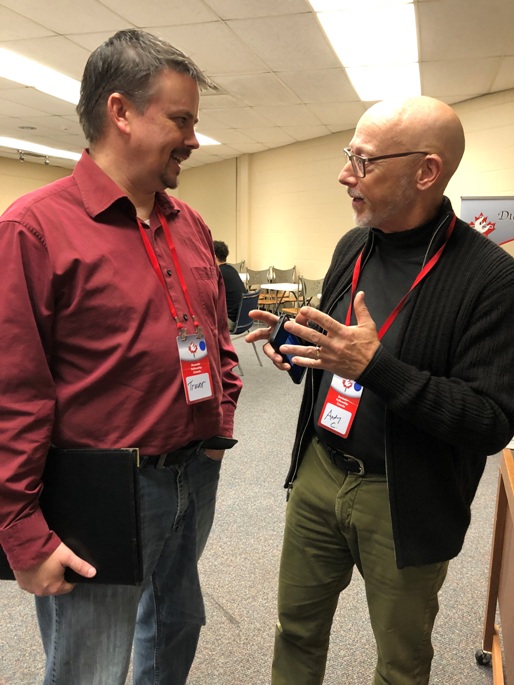
Andy Cornell and Rev. Trevor Payton
RF Executive Director Andy Cornell, right, talks with Rev. Trevor
Payton, Executive Director of Dunamis Fellowship Canada during
their fall gathering at Kortright Presbyterian Church in Guelph
on Oct. 15. Andy joined the DFC board of directors earlier this
year. There’s a natural connection between RF and Dunamis as
we are all united in reformed orthodoxy. – Patti Tan Photo

Prior to the pandemic, speaking to congregations and holding encouragement road trips was a major part of executive director Andy Cornell’s job.

Andy’s first road trip was to British Columbia in May of 2018, followed by New Brunswick in September 2019 and Alberta and Saskatchewan a few weeks later. In 2019, he logged 16,755 kilometres (by land, sea and air) to meet with ministers and congregations. In 2020, it was 222 km. In 2021 — zero.

As we emerge from the distancing, the trend thankfully appears to be reversing. His mileage so far in 2022 is 2, 218 km.

Andy is willing and able to speak to congregations within the PCC on any day of the week. It can be a Sunday service or a midweek group. He can be reached at <amcpastor1@gmail.com>.

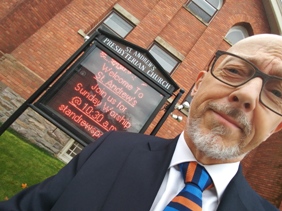
Andy Cornell in Parry Sound

RF Executive Director Andy Cornell brought the Word to St. Andrew’s in Parry Sound, Ontario, on Sunday, Oct. 16, 2022. It was his first appearance before a congregation in more than three years. Post-pandemic reopenings might see a return to more road trips. Wait and see!

Renewal News Fall 2022

Renewal News

Download the entire issue in PDF format, or read and comment on the individual articles as follows:

A Time of Transition

By Deb Stimphil, RF Board Chairperson.

In Psalm 40, David says “I waited patiently for the Lord; he turned to me and heard my cry. He lifted me out of the slimy pit, out of the mud and mire. He set my feet on a rock and gave me a firm place to stand. He put a new song in my mouth, a hymn of praise to our God. Many will see and fear and put their trust in the Lord.” (vs 1-3)

Many of us are waiting patiently for the Lord. Some of us may have experienced God hearing their cry, and they have a new direction; they are standing on a firm place.

Others are in a place of transition. We feel like we are being lifted out of the pit but are not just yet on the rock.

Others are still waiting patiently on the Lord. They haven’t yet heard from God. But they know He hears them and will answer their prayers.

We at St. Andrew’s Welland are in a time of transition. Our pastor retired and a new chapter is opening for us. We are on a journey. I am sure that if this church is faithful to God’s Word, He will set our feet on a rock and give us a firm place to stand.

Many of us who are holding fast to orthodoxy are still waiting patiently for the Lord. Renewal Fellowship, along with Vaughan Community Church, are holding a Pastor Retreat in November. This will be a time where pastors can get together, share fellowship with one another, share burdens with one another and wait patiently on God.

We are tired and worn down from many things. This retreat will be a time to recharge in the Spirit of God. Fellowship is so important to the body of Christ and all of us have missed the fellowship during the last couple of years. So, plan to attend this event. It can be a time of renewal for all of us.

The Minister as Intercessor

An excerpt from A. Donald MacLeod’s latest book.

An explanation for this book.

My wonderful 21-year-old grandson, Callum, asked me two questions as we were discussing his future: “What is it like to be a minister, Gramps? How has the ministry changed since you were ordained back in 1963?” It is to respond to these questions that I have set out my answer, in hopes that it will clarify both his understanding, and share what I’ve learned during my years of service. — ADM

Chapter 5 – Ministry to a New Generation

Writing about the prayer life of a minister, I must start with a disclaimer. There is no subject that makes me feel more inadequate, more prone to the complaint that I am a hypocrite, but I know of no minister who feels that his or her prayer life is totally adequate, as the sheer pressures and time constraints of our profession make it very difficult to find the time we need to spend on our knees. It is also one of the most subtle (and sometimes not so subtle) temptations of the Evil One to keep us from this essential ingredient of a fulfilling and life-changing ministry. In eternity, the question will be asked of each of us, as to how faithful we have been in our prayer life, and I can speak only for myself when I admit that I have been sadly deficient in this regard. With this caveat, I proceed to the Scriptural teaching about the minister as intercessor, and turn to the life of our Lord. I have always found helpful a marvellous book, Our Lord Prays for His Own, by Marcus Rainsford, who pastored first in Dundalk, Ireland, and later at St. John’s Church in Belgrade Square in London. His classic treatment of John 17 provides soul-searching explanations of our Lord’s high-priestly prayers for His followers as He was on His way to the cross. Jesus is our example and there is no better illustration of this than His prayer for Peter as He and the disciples gathered at the Last Supper, and he indicated that he was praying for Peter that his faith not fail. As I have asked the Lord to strengthen the commitment of a faltering parishioner, I have often thought of His prayer and recognized that although there may not be an immediate answer, we can be sure of one at the end, in His will, because He is faithful.

Our Lord prays that His disciples will be one, even as He and His Father are one, and that He would, in His time and good pleasure, fulfill His purposes in our lives, as His intercession combines with our prayers to keep those who are under our charge faithful and fruitful. My own praying for my congregants started early in my ministry as I found myself in conflict with the woman who provided a student minister with room and board in her guesthouse. For some reason she took an immediate dislike to me, and did everything she could to thwart my ministry. One day I picked up the party line at our house to call a parishioner, only to hear her lambasting the new student, and advising her friend not to return to church the next Sunday. She was also the organist at this small country church, and one Sunday, minutes before worship was to begin, she decided she would not turn up to play. Fortunately, we had an alternative, and a replacement was quickly arranged, but it was a shattering experience, and I barely got through the service. I prayed urgently that the Lord would remove this trial, but she stayed on and remained as organist, though I was able to make alternative boarding arrangements the next summer.

A second challenge occurred the night I learned, at the very end of my posting, that a family in my congregation, returning from a holiday in Saskatchewan, had had a serious car accident and three parishioners had been killed. I remember standing outside the home of the family I was visiting at the time, and prayed earnestly to the Lord that I would be given strength as I went to visit the bereaved family that dark night. The sad thing was that I had neglected my own personal devotional life for several days previously, and had to be reconnected with Jesus, but the Master came and healed me and used me in turn to bring healing in that terrible situation. Four days later, as mourners crowded the packed church to pay their last respects, Dr. Reid supported me as he preached a magnificent sermon.

The whole incident was a powerful reminder to me, as I started my final year in university, that God was in control of my life, and how essential both my devotional life and my dependence on Him would be for an effective prosecution of a Gospel ministry.

One of the powerful resources for my prayer life throughout my years of ministry has been a diligent study of Paul’s great prayers for his correspondents in his epistles, as he lists the requests he makes for the congregations in Corinth, Galatia, Ephesus, Philippi, as well as in the letters to Timothy and Titus. We can connect with him and I have often turned to his words in specific intercessions during my prayer times, naming people and situations. It means that I do not deal in generalities, but focus on particular needs and individual requests.

When I came to start a new church in Scarborough, suburban Toronto, I found the pressures of beginning a church from scratch very demanding, but also very exhilarating. Things were going well, and the congregation was growing as we approached the building of a new edifice, but then a problem occurred, and everything seemed to fall apart. Two prominent families in the church were caught up in a moral crisis, and I blundered in where angels would have feared to tread. Both families left our church, along with several others, and I poured out my heart to the Lord in desperation. The Rev. Gerald and Kitty Griffiths, who had had a connection with one of the families called me to say they were en route to catch a plane at Pearson and would stop by to see us. They came in and prayed with me and I shall never forget their intercession which sustained me in a dark moment, and gave me strength for the journey.

I also received reassurance from a denominational official, the Reverend Howard Doig. We clergy need each other’s support as no one else can fully understand the challenges we face. As I was thrown upon the Lord, blessing and growth came that summer as they had never done previously. Once again, challenges in the ministry brought me back to the Source of my strength, and I was grateful to the Lord for His presence and peace.

While I was in ministry at Knox Church, Toronto, I discovered the benefits of a “monthly prayer day.” I would go off to our denominational retreat centre in Crieff, where a cottage was made available for me in beautiful woodland surroundings. There I would shut the door, take out my Bible, and furiously write out my prayer needs in longhand as I cited all the situations in my ministry that needed intercession. Then I would commit them to the Lord in prayer. I never returned from those days apart without peace restored and calm gained. I have kept those pages and as I look over them I see how faithful God has been in His presence and grace.

I remember John Allison, a beloved minister in the PCC now gone to glory, who would list his prayer requests with a blank column on the right side of the page to record when an answer was given or how it was resolved. John, who had been a fellow student at Westminster Seminary, experienced challenges in his years as pastor in British Columbia and Ontario. He was known as a great person of prayer, and whose premature death saddened us all. As his former roommate, I can still see him at 6 a.m. every morning, kneeling beside our bunk bed where he had the lower level with his feet turned outward in prayer, as he would spend more than an hour each day in intercession. No wonder God powerfully used him through the years of suffering and challenge.

In subsequent years, when I moved to the city of Boston, I was able to make use of a Roman Catholic retreat centre, where I found consolation and courage in my times of solitude and prayer. I did not need a rosary to systematize my intercession, but found again that systematic writing out of prayer needs kept me on target and disciplined a mind that could easily be distracted during those times.

Confidentiality and discretion are essential in group prayer, particularly clergy group prayer. Gossip must be avoided. Some years ago, while I was in Boston, there were a number of evangelical young PCUSA pastors who gathered in a small New Hampshire village every month for support and prayer. All went well at first, and I was grateful that my assistant, fresh out of seminary, had found courage and strength there, but then I started to hear reports that she had requested prayer for her relationship with her “difficult senior pastor.” The complaint was that I had not allowed her equal time in the pulpit with me, and that I had been overbearing.

It compromised my relationship with several of those pastors, which was awkward.

One of the greatest helps in my devotional life has been my use of certain classic books on prayer. As a teenager I was introduced to Hallesby’s book, Prayer, and subsequently Augustine’s Confessions and books written by Oswald Chambers, Amy Carmichael, and A.W. Tozer.

Books of prayers were also useful. When I was a child, my father would conduct our daily devotions from A Chain Of Prayer Across The Ages: Forty Centuries Of Prayer, 2000 B.C.-A.D. 1912, compiled by Selina Fitzherbert Fox and published in 1913, which incorporated prayers from many sources. Dad used to say that this kept us from wandering and was helpful in focusing both our language and our content. He also would bring us regularly to Anglican Evensong which was a beautiful worship experience based on the magnificent Book of Common Prayer of the Church of England. We attended memorable worship services in St Andrews Church on Nathan Road in Kowloon. Some of those prayers still illumine my own language in prayer and intensify my understanding of talking with God, so that my thoughts do not wander. Our family worship had been a very powerful experience growing up, and I attempted to recreate it for my own family worship. We made prayer a family experience which we hope provided inspiration for our children and grandchildren. On a

memorable trip to the UK in 1966, a friend from Harvard Graduate School days, the Rev’d Michael Higgins, who was then a curate in an Anglican Church, introduced me to The Minister’s Prayerbook, It became a vade mecum for me over the following decades.

The practice of intercession is the greatest instrument the Holy Spirit can use in our ministry, and we neglect it at our peril. God is waiting to bring blessing to us as we wait on Him. The power of our public praying as we lead a congregation in worship is determined by our personal prayer. “You have not because you do not ask.”

A. Donald MacLeod
A. Donald MacLeod


Christian Ministry Today
is the working title for this book. Publication arrangements to be finalized.

A. Donald MacLeod is a former research professor of church history at Tyndale University College and Seminary in Toronto. He was born in Philadelphia and studied at McGill, Harvard and Westminster Theological Seminary. He was ordained as a minister in the PCC and served as a pastor and church planter. He was president of the Evangelical Fellowship of Canada from 1973 to 1975 and General Director of the InterVarsity Christian Fellowship of Canada from 1975 to 1980. He helped establish The Renewal Fellowship within The Presbyterian Church in Canada and served as its Chairman from 1980 to 1985. He also served as Senior Minister of Newton Presbyterian Church in Boston. He is on the Appendix to the Roll of he Presbytery of Kingston.

Living the Name

Renewal Fellowship’s Living the Name prize has been awarded annually since 2010 to Knox College students who show interest and promise in evangelism and mission. Congrats to this year’s recipient, Sonia Brulé. We invited her to share her testimony as she begins her call to ministry.

Sonia BruléSonia Brulé

My name is Sonia Brulé and I am the Children and Family Ministries Coordinator at Oakridge Presbyterian Church (OPC) as well as a Volunteer Prison Chaplain at Elgin Middlesex Detention Centre, both in London, Ont., where I live with my husband Chris, and our children Connor (17) and Giuliana (14).

For over 13 years, I have had the privilege of being the Children and Family Ministries coordinator at OPC. Jesus spent His time on earth teaching others to follow God’s way. It was clear through His teachings that spiritual education was important, not only for His disciples but for people of all ages, in order to develop a deep desire for God. I believe when we equip people to encourage one another in the love of Christ, reaching out in service, just as we have been commanded to do, we are doing God’s will.

Prison Ministry has been extremely fulfilling for me as I get to go and share the Gospel to those who cannot enter a church. To see the inmates open their hearts to Christ at the lowest points of their lives is incredible. I truly believe that God can transform lives by touching even the most hardened heart renewing their spirit.

My vision for ministry has really been shaped by Matthew 25:35-40 — “For I was hungry and you gave me food, I was thirsty and you gave me something to drink, I was a stranger and you welcomed me, I was naked and you gave me clothing, I was sick and you took care of me, I was in prison and you visited me.” Then the righteous will answer him, “Lord, when was it that we saw you hungry and gave you food or thirsty and gave you something to drink? And when was it that we saw you a stranger and welcomed you or naked and gave you clothing? And when was it that we saw you sick or in prison and visited you?” And the king will answer them, “Truly I tell you, just as you did it to one of the least of these brothers and sisters of mine, you did it to me.”

Living Stones: A Movement of Reformed Churches in Canada

While the Renewal Fellowship’s mandate and current mission is to provide Prayer and Care for those who adhere to orthodoxy within the PCC, we recognize that some brothers and sisters are being called to depart. The following announcement was prepared by Living Stones and may not necessarily represent the views of the Renewal Fellowship’s leadership. It’s shared for your information and for prayer.

Living Stones: A Movement of Reformed Churches in Canada

Sisters and Brothers in Christ,

The past years in the PCC have been challenging and heart-wrenching at times. As we see the shift in theological convictions more and more rapidly taking a path that is further and further from the foundations of scripture and our Reformed faith and as we experience less and less favour as evangelicals in the church, we hold onto the truth that God is sovereign and on the throne of the kingdom. We know that God shows us great grace as we are called to show for others who we disagree with. For some of us, the changes in the PCC in the past years have led us to the point of recognizing that there is no longer a place for us in the denomination we have called home. We feel bound from doing the ministry we have been given and we are tired and weary of spending energy to walk against the flow of the PCC. We recognize that many will not discern that God is leading them away from the PCC, but for those that do, Living Stones will become a new home. This email is to introduce you to Living Stones: A Movement of Reformed Churches in Canada – a new church affiliation that is rooted in our Reformed traditions but focuses on empowering the grassroots ministries of local congregations and missions. We have been working towards this on some levels for several years and it has come to fruition since the 2022 General Assembly. We will soon be federally incorporated and seeking charitable status. The first congregations will begin to be recognized sometime in the fall of this year and some pastors will join even sooner.

Whether or not you feel called to remain as a faithful witness in the PCC, we want to invite you to learn about us and be in relationship with us in some way. Perhaps some of you have already had people leave your congregation. Rather than have them wander into the dusk, consider referring them to Living Stones so that we might be able to offer some form of ministry to them. If you are considering a withdrawal yourself, we would welcome hearing from you. We have monthly town hall meetings that are confidential to share information and pray together.

To learn more about Living Stones, just check out our new web site. It is a work in process as are our documents on Vision, Doctrine and Polity but they are our starting point. Please use the Contact Us form on the site if you have further questions.

Living Stones: A Movement of Reformed Churches in Canada

Blessings from your brothers and sisters in Living Stones.

Renewal News

Renewal News Summer 2022

Download the entire issue in PDF format, or read and comment on the individual articles. A longer report on “GA Takeaways” appears online than in the PDF version.

In this issue:

GA Takeaways

Defining moments from General Assembly 2022

The General Assembly of The Presbyterian Church in Canada provides a four-day snapshot of the state of the church. Anyone concerned about the evangelical renewal of the church would have heard numerous causes for concern.

RF Executive Director Andy Cornell watched the entire proceedings and compiled notable and telling quotes from General Assembly debates which highlight the challenges before us.

(NOTE: A condensed version of this account appears in the Summer 2022 printed edition of Renewal News.)

________________________

“At the 145th GA there was a non-binding vote that resulted in an expression of desire to become fully affirming, and then two motions on marriage and ordination were passed and sent down through the Barrier Act. Those two remits were approved. And in addition, the 146th GA, in adopting all the recommendations from the Rainbow Commission Report, declared the PCC to be an affirming church. The remits ‘B’ and ‘C’ are implementations of part of this shift to becoming an affirming church. Those two remits enact a permanent grandfathering of two definitions of Christian marriage and permitting ordination of LGBTQi peoples without discrimination. There was never an attempt to balance theologies of marriage but rather within the context of an affirming church to permit liberty of conscience and action, which was a bold and controversial step, considering that the ordination of women only permitted liberty of conscience but not action. This non-balancing of theologies, or at least the proposed balancing of theologies of committees and agencies goes against much of our big tent thinking. Non-balancing is quite similar to our different theologies of wealth and poverty, peace and war, and yet, we do not require balance of membership on committees. The balance we are seeking, through this special committee report and overall, is a balance of voices from non-dominant peoples and cultures, not theologies.”Matthew Sams (East Toronto)

“I appreciate Matthew Sams for tipping his hand because basically what he is saying is showing us that evangelicals do not have a safe space moving forward in this church, that liberty of conscience, since it is nonbinding, can in fact be removed and, according to Mr. Sams, probably will be removed going forward. Thank you for showing us that the church is not a safe space for conservative theologies moving forward. There are many of us in our church who do share the theology of our ethnic congregations. We will be coming to other discussions later on about how we live together in this new reality. So, I think this discussion has just set the stage, and I would certainly vote against this motion, because evangelicals who have voted in favour of the remits will see where we are headed going forward.”Timothy Ferrier (Barrie)

The issue was recommendation SCP-009 from the Special Committee Responding to Petitions 1 and 2 (2021) from the two Korean-language presbyteries alleging generational “silencing, slander, ridicule, racism and “mistreatment” to ethnic groups. The recommendation called on the Assembly to “instruct the Assembly Council, the General Assembly Office and Life and Mission Agency and Committee to Nominate Standing Committees and the other boards and committees of the church to ensure that there is balance and respect for both definitions of marriage in all correspondence sent to congregations, sessions, presbyteries and synods; the delivery of resources and workshops, and the membership of the boards and committees of the church; also that the Assembly Council provide progress reports on the balancing of the two definitions of marriage in the life of the church to the General Assemblies of 2023 and 2024.”

Matthew proposed an amendment to remove all references to “balance.”

The committee, in its report, recognized a very high correlation between non-Anglo congregations and traditional theology. Mandating equal resources would be a tangible effort to demonstrate to ethnic churches that they are welcome, and they belong.

Timothy noted the word “grandfathering.” The Oxford English Dictionary defines it as “exempt (someone or something) from a new law or regulation.” In other words, to make an exception from the rule. Inclusion would be the rule.

Other commissioner comments:

“Balance and respect has been assured in these remits. We don’t need to continue to study and debate this any further. I don’t think this work is necessary and I think it has very little to do with the harm done to non-white Presbyterians, which was the mandate for this special commission…. This goes beyond the scope of what they were asked to do.”Cherie Inksetter (Niagara)

It really is troubling with the possible view of colonizing our view of sexuality of the West upon non-white ministries who, I can tell you with authority, are very troubled by the remits. I pray and I hope that we will not look at this as inclusion and exclusion, but as an opportunity, if possible, for this church to stay together as a big tent…” — Emery Cawsey (Kamloops)

“It isn’t as much about balance as it is to let the public know that the PCC denomination holds to two faithful, parallel definitions of marriage… This bears on our witness to our ethnic community. I want to let the court know that as soon as the remits were passed, everyone thought, or they believed, that the PCC has changed the definition of marriage to between two people – that’s it. This recommendation is to witness and to let people know that the PCC has a place for both definitions of marriage and that’s the essence of this recommendation. It is about balance but it’s more about bearing witness, particularly to ethnic communities that the PCC can welcome both definitions of marriage and hold to both definitions of marriage and be able to belong to this denomination.”Jinsook Khang (Eastern Han-Ca)

Commissioners approved the removal of “balance” by a vote 106-85.

The amended motion: “That the General Assembly instruct the Assembly Council, the GAO and LMA and Committee to nominate standing committee and the other boards and committee of the church to ensure that people are not excluded from serving based on their theological conviction of either definition of marriage endorsed by the GA.”

Discussion regarding the amended motion:

“We are in an exercise of listening, particularly to our Han-Ca brethren and sisters and the committee has done a wonderful job of helping us hear and listen. We are being watched and many members of our denomination are watching to see where this General Assembly is taking us and this particular vote is going to be a signal, a very clear signal, one way or the other. And this gives me great and deep concern for our brothers and sisters in the Han-Ca presbyteries. I believe we are not listening to them and that’s really very sad.”George Anderson (Hamilton)

“This is what everyone was wondering about when we came into the court this week: how would we walk out remits ‘B’ and ‘C’. Some people are suggesting it’s about participation in ordination once in a while. Some would be bold to say that nothing has changed for traditional and conservative Christians in the church. But the fact is that’s not their impression. Their impression is that the church has completely changed its understanding of a number of things: of Scripture, of subordinate standards and one another. This question will not only apply to this motion but will be the theme for many of the other things we will be talking about. I have to vote against this motion and against the understanding that we don’t somehow have to walk out what the remits mean in terms of two cultures, two understandings of Christian faith together. It’s so much more than about marriage and ordination; it’s much more than that…. The larger tent is what I’m hoping we will be able to work out together.”Jonathan Dent (Ottawa)

The amended motion carried 100-89.

________________________

It’s much better to stay together as one denomination and still talk to each other.” – Barb Sargent (Essex-Kent)

A total of 25 overtures made in 2020 and 2021 sought the creation of theologically based synods to allow conservative congregations to adhere to traditional theology. Assembly Council (AC) established a seven-member working group from its own membership to study the issue and prepare a response to these requests along with overtures allowing congregations to leave the PCC with their buildings and assets. AC’s response was “that leaders find ways to function effectively in current structures with consensus building and not view matters as insurmountable.” (Barb was among three members of the working group who had a minority opinion.)

There is a divide. This proposal could allow us to work together.” Lisa Aide, (Essex-Kent).

People will end up leaving and departing.” — Jonathan Hong (Eastern Han-Ca).

Commissioners approved AC’s response 113-71.

________________________

Is this truly the heart of the church?” Matthew Lingard (Hamilton)

Matthew was responding to the AC recommendation to allow congregations to voluntarily withdraw from the PCC and receive 50 per cent of the value of their net assets. (If a congregation wanted to retain use of its building, it would have to pay the PCC half of the cost.) The proposal was in response to dozens of overtures in recent years.

Noting the high cost of departure, Lingard asked: “What sort of legacy will we be leaving?”

“This is a loving, caring and wise approach.” Deborah Jones-Synders (Brampton)

It’s punitive to take 50 per cent.” – Emery Cawsey (Kamloops)

Would 50 per cent be compassionate to you?” – David T. Sturtevant (Newfoundland)

“Asking 50 per cent is certainly not in the Spirit of Christ.” – George Anderson (Hamilton)

This is a compromise.” – Marianne Emig Carr (Seaway-Glengarry) who pointed out that currently a congregation whose members depart would have to leave their building behind and receive nothing.

Commissioners approved the voluntary withdrawal process 117-74

________________________

The motion is attempting to set up something that informally already exists…. organizations, some of them have been around for a number of years, already exist for like minded folks and have never needed Assembly’s permission to be established or to associate.” Thomas Kay (Prince Edward Island)

The Special Committee dealing with the racism petitions recognized the need for mutual support in a divided denomination. The committee wondered “about the only congregation in a presbytery who has called a same sex married minister. Where does that minister and that congregation find collegiality, support and encouragement in an open and safe space? The same can be said the other way round, where a minister and congregation hold to a traditional definition of marriage in a presbytery where the rest of the ministers believe that marriage is between two adult persons.”

The committee recommended further study to determine if such associations would be helpful. Commissioners agreed by a vote of 121-61.

________________________

We can do better.” (Part 1) – Peter Bush (Waterloo-Wellington)

Peter challenged Assembly Council’s all-or-nothing response to his presbytery’s overture asking that some of the denomination’s investment income be used to:

  1. provide $10,000 per congregation in seed money grants to assist congregations in improving the energy efficiency of their church buildings and/or in moving off-grid,
  2. provide $10,000 per manse in seed money grants to improve energy efficiency and/or to go off-grid,
  3. provide $20,000 per multipoint change to assist in the purchase of a hybrid or electric vehicle for the minister,
  4. provide $5,000 grants to congregations interested in building charging stations on their property.

The request was made considering widespread acceptance that “climate change has been described as ‘the existential crisis of our time’” and the fact that past General Assemblies have spoken about the need for change. The response from AC assumed that every congregation would apply for and receive a grant for every item, which would cost $15,835,000. In response, the council pointed to existing government grants or applying for a loan from The Presbyterian Church Building Corporation for building improvements.

Commissioners agreed by a vote of 95-92 to send it back to the council for more study.

________________________

 We can do better.” (Part 2) – Peter Bush (Waterloo-Wellington)

Peter was commenting on the response from the LMA to the 2019 overture from Calvin Presbyterian Church in Toronto, which requested that “the church’s theological colleges and the Life and Mission Agency work together to amend their curriculums and programs to include, administer and promote the creation of a network of voluntary student charges or placements, with an emphasis on congregations that do not currently have Reformed and trained leadership, for which students will be remunerated and/or receive credits or tuition relief for their services.”

It was requested for several reasons, notably to help “congregations and pastoral charges without pastoral leadership” especially in remote areas and particularly those “served by non-Reformed or unsuitable or untrained pastoral leadership.”

For several reasons, LMA rejected student charges as “impractical” and suggested that presbyteries create more multi-point or cluster ministries or seek an LMA grant.

Said Bush: “I fully agree with the answer as a multi-faceted thing that goes way beyond the colleges’ function. But the answer provided… does not move beyond that narrow question. A response, I would hope, would say something like, ‘The idea proposed by the overture won’t work but we have some other ideas.’ We need to think creatively about other options. We can do better than this response. We can be more creative.”

Commissioners agreed. The motion to answer the overture considering the LMA’s concerns was defeated with 70 in favour and 111 against.

________________________

It’s important to find new ways to do ministry… what we are doing is not working.” Doris Eaglesham, Niagara

LMA followed up on its 2020 survey which found that of 696 PCC pastoral charges in total, 244 were officially vacant but only 30 were actively looking to call a minister. LMA followed this up with a survey of presbyteries to determine the underlying reasons. Lack of finances was a factor for 18 of the 26 presbyteries which responded.

Said the report: “Some presbyteries indicated that distance was a factor for interim moderators who made lengthy drives to attend meetings or conduct pastoral visits. Respondents also remarked on the heavy workload for interim moderators who were not only responsible for their own congregations but also for the additional congregations they were charged with serving… [and] heavy workload for retired ministers within their bounds who were increasingly called upon to serve as interim moderators or stated supply.”

Of the 771 pastoral charges in the PCC in 2003, 128 were officially vacant and not seeking a new minister (16.6 per cent.) In 2020, the PCC had 696 charges, of which 218 were not seeking (31.1 per cent).

LMA asked that its surveys be sent to presbyteries, sessions and congregations for study and reflection. Peter Bush (Waterloo-Wellington) amended the motion to encourage presbyteries to “be innovative and experimental.” Commissioners approved the amendment 183-6 and the amended motion 194-0.

________________________

  • For the full text of General Assembly committee reports cited below, go to https://assembly.presbyterian.ca/#/ and click on the “committees” tab.
  • For the draft minutes of each sederunt: using the above link click on “resources.”
  • For more information about The Renewal Fellowship within The Presbyterian Church in Canada, go to /

Renewal News – Spring 2022


Download the entire issue in PDF format, or read and comment on the individual articles:

In This Issue:

Check out the list of Renewal Day Watch Parties – Renewal Day with a twist.

Register for the April 2022 Renewal Café.

Stillness Amidst Agitation

And the beat goes on.

I arrived in Simcoe just as the 2008 recession was digging its tenacles into every fibre of society. We more or less recovered, at least economically; but it seems there have been constant and serious seismic shivers shaking life ever since. The past many months have only intensified the severity and increased the size of the sample. This morning as I sat to pen this piece, reports of Russia’s invasion of Ukraine have exploded onto the news — not the consoling information one longs for!

While occasionally lashing out (okay maybe more than occasionally) and pondering best ways to respond and trying both to discern watershed moments from irritating drips and to separate truth from error, I have found myself almost constantly churned up – in my mind, in my heart, in my spirit.

Perhaps you, too, have found yourself in such a “disturbed” state. (I used that word so all my “friends” – both of them – could have a cheap shot!) If you are also stirred up, read on. I have learned that the loss of regular in-person interaction has contributed to my pervading inner unrest. Phone or Zoom chats (wonderful as they are) don’t allay like a face-to-face encounter. Even when they are intense and contested, there is often a healing, cathartic element that arises and the proverb that asserts “iron sharpens iron” is commonly experienced.

However, after contemplating my ongoing inner agitation, I have been drawn back to a deep affirmation. The shortest statement of this counsel is found in the Psalms. “Be still, and know that I am God” (46:10). Earlier in the Psalm, descriptions of turmoil and upheaval are given as the context into which this verse is addressed.

For people who are active doers, more attuned to serving and sacrificing, this call to “centre down” is challenging. For a society, more and more prone to the instantaneous – in feedback, in response, even in meal preparation – the implied time needed to quiet a troubled mind, heart, and spirit is counter-cultural. Yet, I am more and more aware that this is a summons from the Spirit to me (and to you?).

“Ian, be still. Push all the political, societal, cultural, and denominational upheavals aside. Remember (know) who I am (I AM) – the sovereign ruler of the universe who is with you.” I’m not very good at this “centring stuff.” That’s another reason I miss in person interactions. When I am with others, they often help me remember what I have neglected.

Good news! Lent is here. Stillness (or extra stillness) is a good discipline to take us to Easter and into the ongoing upheavals of 2022.